
When Attention Isn't Just ADHD: The Hidden Role of Vision in Focus and Learning

A seven-year-old sits in his classroom, fidgeting constantly, losing his place while reading, and struggling to complete assignments. His teacher suggests an ADHD evaluation. His parents schedule an appointment, complete rating scales, and within weeks, he's on stimulant medication. Yet his struggles persist.
What if the real culprit wasn't attention deficit disorder at all, but an undiagnosed vision problem?
This scenario plays out in classrooms across the country more often than most people realize. While ADHD is certainly a legitimate condition affecting many children, mounting research reveals that visual dysfunction frequently masquerades as attention problems, leading to misdiagnosis, inappropriate treatment, and missed opportunities for effective intervention.
The Startling Overlap
The connection between vision problems and ADHD-like symptoms is more significant than most people understand. Research shows that 15 out of 18 symptoms commonly associated with ADHD also appear in children with vision disorders. That's over 80% overlap between the two conditions when based on symptoms alone!
Children with ADHD are significantly more likely to have refractive errors, strabismus, convergence insufficiency, and color vision anomalies compared to their typically developing peers. Meta-analyses involving tens of thousands of participants reveal that children labeled as having ADHD have nearly twice the odds of having astigmatism or hyperopia, nearly double the risk of strabismus, and three times the risk of having convergence insufficiency.
The reason for this is because the visual system is far more complex than basic eyesight. While roughly 5% of visual processing occurs in the eyes themselves, the remaining 95% happens in the brain, integrating with touch, hearing, proprioception, and cognitive functioning. When this intricate system breaks down, it can create symptoms that look remarkably similar to attention deficits.
How Vision Problems Mimic ADHD
Consider convergence insufficiency, one of the most common binocular vision disorders. Children with this condition struggle to keep their eyes properly aligned during near tasks like reading. The constant effort required to maintain single, clear vision leads to eyestrain, fatigue, and difficulty concentrating. Text may appear to move, blur, or double. The child loses their place frequently, skips lines, and needs to re-read passages.
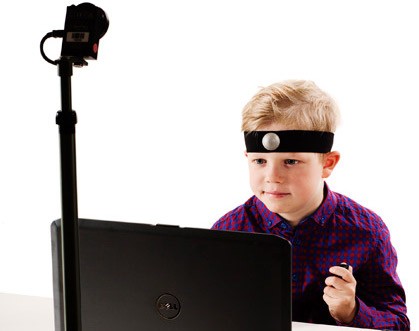
From an observer's perspective, this child appears inattentive, distractible, and possibly hyperactive as they fidget and take frequent breaks. They might avoid reading altogether, seeming oppositional or lazy. If tested using the Qb test, this child’s results would be skewed because of the inability to maintain comfortable fixation on the screen. These behaviors perfectly mirror ADHD symptoms, yet the root cause is entirely different.
Accommodative dysfunction (difficulty focusing at different distances) creates similar challenges. A child whose focusing system can't efficiently shift between the whiteboard and their desk work, or who cannot maintain their visual focus while looking at their Chromebook situated less than 20 inches in front of their face, they will appear inattentive as they struggle with these visual demands of classroom learning.
Even uncorrected refractive errors contribute to attention difficulties. A child with undiagnosed hyperopia might pass basic vision screenings, considering that they only check a child’s distance eyesight, but experience visual fatigue during sustained near work, leading to decreased attention span and acting out when it comes time to doing schoolwork or homework.
The Attention-Vision Connection
The relationship between vision and attention runs deeper than simple overlap of symptoms. Attention serves as a critical filter for the millions of bits of visual information our eyes receive every moment. Our visual system is designed for constant movement: the eyes reorient about three times per second through rapid saccades, allowing high-acuity vision to continuously sample different parts of our environment and create the scene in our mind's eye of the world in front of us and surrounding us. To provide a simple catch phrase that I use daily in clinical practice – “we move our eyes towards where we want to pay attention”.
This system requires incredible coordination between eye movements and internal attention shifts. When visual efficiency breaks down, the brain must work overtime to process visual information, leaving fewer cognitive resources available for sustained attention, learning, and behavioral regulation.
Research demonstrates that when visual processing load increases, such as when the brain must cope with double vision, or make sense of information that is processed sequentially out of order, information processing capacity drops significantly from 80% to 50%. This increased cognitive load makes it nearly impossible to sustain attention on academic tasks.
The Treatment Response
What makes this connection particularly compelling is how children respond to optometric vision therapy. Studies show that addressing underlying visual problems often reduces ADHD-related symptoms naturally with and without medication. When convergence insufficiency is treated with vision therapy, children frequently show improvements not only in visual function but also in attention, reading performance, and classroom behavior. I have seen hyperactivity decrease significantly even in medicated children through completing optometric vision therapy.
Now this is not to suggest that all attention problems stem from vision issues, or that ADHD isn't a real medical condition. Rather, this highlights the need for truly comprehensive evaluations whenever a child is struggling in school with “focusing”.
The Diagnostic Challenge
Unfortunately, vision problems remain among the most overlooked explanations for attention-deficit symptoms. General awareness of vision-related learning problems is low, and most ADHD evaluations focus primarily on behavioral symptoms rather than potential underlying causes. More to the story, in my area there are even clinicians using the Qb Test to diagnose children with ADHD without any cognizance of how it creates false positive results for those children who have vision disorders.
Moving Forward: A Call for Comprehensive Care
The implications of this extend far beyond individual children; they affect our entire approach to attention difficulties. Rather than rushing to symptom-based diagnoses, we need comprehensive evaluations that investigate potential root causes.
Every child presenting with attention concerns deserves:
- Thorough visual assessment including binocular vision, accommodation, and visual processing skills
- Evaluation of sleep patterns, medical history, and developmental factors
- Assessment of learning abilities and cognitive processing
- Analysis of environmental demands and sensory needs
This doesn't mean delaying appropriate ADHD treatment when clearly indicated. Instead, it means ensuring that visual contributors are identified and addressed as part of comprehensive care, rather than brushed aside because the child has the ability to see with 20/20 eyesight.
The Bottom Line
Vision and attention are intimately connected systems. When we overlook visual dysfunction in children with attention difficulties, we miss opportunities to address treatable root causes of their struggles.
For parents, educators, and healthcare providers: attention problems deserve more thorough investigation than what is being currently done. Behind every child who can't focus may be a visual system crying out for support. When we take the time to look deeper, literally, we often find solutions that can transform a struggling child's experience in the classroom and beyond.
The goal isn't to eliminate ADHD as a diagnosis, but to ensure it's accurate and that all contributing factors are addressed. Children deserve nothing less than comprehensive care that sees the whole picture.
Conditions We Treat
If you or your child is experiencing any symptoms that lead you to think that your struggles are visual in nature, it's important to take action and seek treatment as soon as possible.
Keep In Touch
Don't wait – contact us today to schedule an appointment and take the necessary steps towards improving your vision and your performance!
Contact Info
Hours of Operation
- Monday 9:00 AM - 6:00 PM
- Tuesday 9:00 AM - 6:00 PM
- Wednesday 9:00 AM - 6:00 PM
- Thursday 9:00 AM - 6:00 PM
- Friday 9:00 AM - 6:00 PM
- Saturday Closed
- Sunday Closed
- Monday
- Tuesday
- Wednesday
- Thursday
- Friday
- Saturday
- Sunday
- Monday
- Tuesday
- Wednesday
- Thursday
- Friday
- Saturday
- Sunday
© 2026 Texas Vision Therapy. All rights Reserved -
Accessibility Statement
-
Privacy Policy
-
Sitemap
Managed and Designed by 