
The Visual Brain at Work: Unlocking the Neuroscience of Reading

Every day, you effortlessly scan through emails, reports, and social media posts without giving a second thought to the extraordinary neurological feat occurring behind your eyes. What feels like a simple, continuous flow of information is actually one of the most complex cognitive processes your brain performs; a sophisticated dance between precise eye movements, specialized brain regions, and lightning-fast visual processing.
Reading Isn't What It Seems
Contrary to popular belief, your eyes don't smoothly glide across text like a scanner. Instead, they execute a series of rapid, jerky movements called saccades, covering about eight letters at a time, followed by brief 250-millisecond pauses called fixations, which is where your brain actually processes the visual information that the eyes see. Think of it like a high-speed camera taking snapshots: you spend roughly 75% of your reading time in these stationary moments, with only 10% actually moving between words.
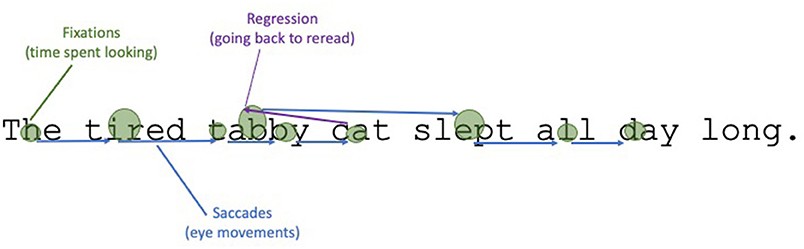
https://kids.frontiersin.org/articles/10.3389/frym.2023.769381
What's particularly fascinating is that during saccades, your vision is essentially suppressed to prevent the blur that would otherwise result from rapid eye movement. You're effectively "blind" several times per second while reading, yet you never notice it.
Your Brain's Specialized Reading Circuit
Reading leverages a remarkable example of neural recycling. Since written language is a relatively recent human invention (only about 5,000 years old), our brains had to repurpose existing visual circuits originally designed for recognizing faces and objects. The result is a highly specialized region called the Visual Word Form Area (VWFA), often dubbed the brain's "letterbox", located in the left hemisphere.
This region acts as a sophisticated filter, instantly recognizing letter patterns and forwarding them to other brain areas responsible for sound and meaning. It's so efficient that expert readers can process familiar words in milliseconds, demonstrating the plasticity of human neural architecture.
The Two-Highway System of Vision
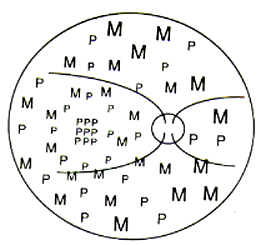
Your visual system processes reading through two parallel pathways, each optimized for different aspects of the task:
The parvocellular pathway handles fine details: the precise shapes of letters and the high-resolution information needed to distinguish between similar characters like 'b' and 'd'. This system provides the sharp, detailed vision essential for accurate letter recognition.
The magnocellular pathway detects motion and manages peripheral vision, playing a crucial role in controlling eye movements and providing the timing signals that coordinate your reading flow. Interestingly, disruptions in this pathway have been strongly linked to reading disabilities, highlighting its importance in fluent reading.
The Strategic Art of Visual Sampling
During each fixation, you're not just seeing one word. Your visual span extends about 20 characters around your fixation point, with a pronounced rightward bias in English (the opposite being true for Hebrew or Arabic readers). This asymmetry isn't due to visual limitations but reflects how attention is allocated based on reading direction.
Your brain cleverly uses "parafoveal preview", the name for processing information about upcoming words before you directly look at them; essentially this is recognizing words out of the “corner of your eyes”. This preview benefit dramatically speeds up reading by allowing your brain to begin processing words before your eyes actually land on them.
When the System Breaks Down
Understanding these mechanisms reveals why reading difficulties can be so complex and varied. Problems can arise at multiple levels:
- Visual efficiency issues like poor eye coordination can consume mental energy that should be devoted to comprehension
- Magnocellular pathway disruptions can create timing problems between the visual pathways
- Working memory overload from inefficient visual processing can leave fewer cognitive resources for understanding meaning
For children learning to read, visual perceptual skills are particularly critical. They must develop the ability to discriminate between similar letters, remember visual sequences, and coordinate their eye movements with cognitive processing, all while building associations between visual symbols and sounds.
Implications for Learning and Development
These insights have profound implications for how we approach reading instruction and support struggling readers. Rather than focusing solely on phonics or comprehension strategies, effective reading support must consider the entire visual-cognitive system.
For professionals in education, training, or human resources, understanding these mechanisms can inform how we design written materials, assess learning difficulties, and create supportive environments for skill development. The research suggests that reading interventions can actually reshape brain networks, offering hope for individuals with reading challenges.
The Takeaway
The next time you breeze through a document or email, take a moment to appreciate the neurological symphony occurring beneath your awareness. Your brain is orchestrating precise eye movements, processing visual patterns through specialized circuits, and integrating information across multiple pathways, all while maintaining the seamless experience of effortless reading.
This hidden complexity reminds us that what appears simple on the surface often involves extraordinary sophistication underneath. In our data-driven world, where reading proficiency directly impacts professional success, understanding these mechanisms can help us better support learning, design more effective communication, and appreciate the remarkable capabilities of the human brain.
The research reveals that reading truly is one of humanity's most impressive learned skills; a testament to our brain's remarkable ability to adapt and specialize for the demands of modern life.
Conditions We Treat
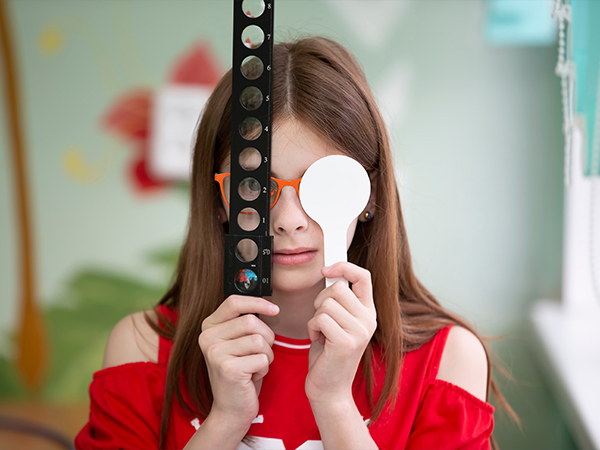
If you or your child is experiencing any symptoms that lead you to think that your struggles are visual in nature, it's important to take action and seek treatment as soon as possible.
Keep In Touch
Don't wait – contact us today to schedule an appointment and take the necessary steps towards improving your vision and your performance!
Contact Info
Hours of Operation
- Monday 9:00 AM - 6:00 PM
- Tuesday 9:00 AM - 6:00 PM
- Wednesday 9:00 AM - 6:00 PM
- Thursday 9:00 AM - 6:00 PM
- Friday 9:00 AM - 6:00 PM
- Saturday Closed
- Sunday Closed
- Monday
- Tuesday
- Wednesday
- Thursday
- Friday
- Saturday
- Sunday
- Monday
- Tuesday
- Wednesday
- Thursday
- Friday
- Saturday
- Sunday
© 2026 Texas Vision Therapy. All rights Reserved -
Accessibility Statement
-
Privacy Policy
-
Sitemap
Managed and Designed by 